Like the Tibetan Buddhist tradition that it evokes, Zhang Huan’s “Three-Legged Buddha” is an artwork of mystery and complexity. It captures life, death, and rebirth. The enormous sculpture is strong and muscular, yet fragile; seemingly dominated yet defiant. Is the key figure within it collapsing, or is it arising?
These are the qualities and questions the sculpture embodies as it sits within the lush South Fields of Storm King Art Center. In July, the Mountainville, N.Y. art center, which brings together nature and sculpture in a magnificent pastoral setting of hills, fields, and woodlands in the Hudson Highlands, installed the sculpture. Standing about 28 feet tall and weighing 12 tons, it is in a clearing amid a grove of maple trees. The sculpture is the gift of the Chinese artist and The Pace Gallery of New York.
This is not a piece that one casually glances at. The sculpture has three gigantic, thick legs, two of them balanced on thin stilts, in a contorted, back-bending image of the Buddha. The third leg and foot are resting atop the upper half of an eight-foot-high head, which has eyes closed. The top edge of the sculpture is rough like mountain peaks.
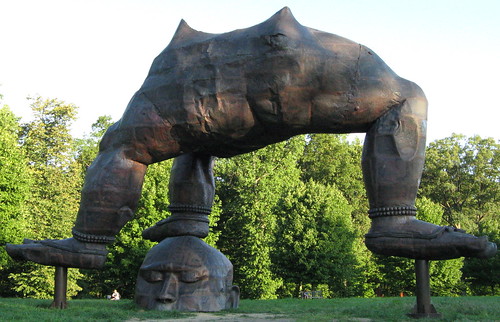
Three-Legged Buddha, Storm King Art Center
Zhang, born in 1965 in the Henan province of China, created this sculpture in 2007. Initially a performance artist known internationally through his edgy, provocative, and haunting works, Zhang has immersed himself during recent years in traditional art practice, specifically sculpting a series of monumental artworks depicting the fragmented extremities of Buddhist statues, according to The Pace Gallery, the artist’s dealer in New York and Beijing.
Of Destroyed Monasteries
“Three-Legged Buddha” is a moving and dramatic sight, all the more so when one understands the source of Zhang’s creation. Zhang set about to make these sculptures after a visit to Tibet in which he found fragments of religious sculptures, which had been destroyed during the Cultural Revolution, for sale in a Tibetan market. Deeply moved by the sight of these fragments, Zhang started to collect them as relics, with an intention to transform them in some way to art, according to Art Knowledge News.
The Tibetan people and their culture suffered immensely during the 1950s and 1960s at the hands of China’s government under Mao Tse-tung, especially when the Chinese authorities suppressed Tibet’s 1959 uprising and during the Cultural Revolution from 1966 to 1976. Chinese groups supporting the Cultural Revolution and some Tibetans who joined them pillaged and destroyed thousands of Tibet’s Buddhist temples and monasteries. Tibet contained more than 6,000 monasteries at the time of China’s invasion in 1950. By the end of the Cultural Revolution, fewer than a dozen were left.
Zhang sensed a mysterious power in the fragments that he found in the Tibetan market, knowing of the religious and historical meanings embedded in them, explains a Pace Gallery release on another of these Buddha works, “Three Heads Six Arms.” In re-creating the fragments on a large scale, the artist believes he can help assuage the pain caused by the original destruction. In a series of these large sculptures based on the smaller fragments, Zhang has combined various body parts – legs, arms, hands, and heads – to personify Buddhist deities.

Being With…
Being present with Zhang’s sculpture engenders many sensations, some disturbing and some inspiring. It has undeniable strength and muscularity, especially in the legs, which are alive with spirit. And yet, the posture of the sculpture and especially the legs seem contorted, like a world twisted by harsh events.
Looking at the sculpture’s brokenness, reflecting the fragments that Zhang found and embodied in the upper half of the head that is under the weight of one of the legs, I consider how religion and spirituality become targets. The authorities, exemplifying the worst aspects of man’s nature, tried to silence and kill spirit in the form of Tibetan Buddhism, literally trying to break it apart in the monasteries and temples.
This, the sculpture says to me, is a world where man tries to crush another’s spirit. It is one where the soul threatens the order of worldly power and so the rulers must put it down, tear it apart. It’s trauma by brute force, one repeated in many cultures and different times around the globe.
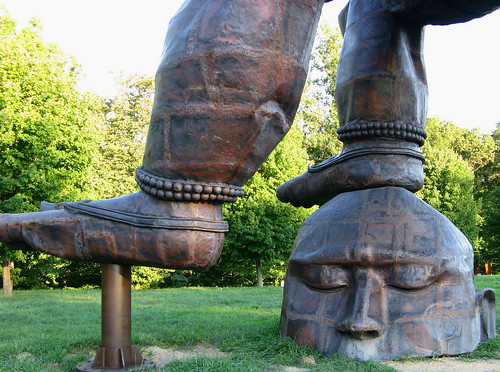

Yet, there is something of non-collapse and calm in the face of the terrible force. The head refuses to yield and survives. The feet have life, the toes have life. Walking around the sculpture and knowing the events in Tibet, I feel the suffering of the Tibetans who practiced their faith in the temples and monasteries. I walk upon the solid ground and feel your silent suffering, feel the feet and the legs that marched and assaulted you for a time – and still do – and yet you survive.
If the sculpture has suffering, we must be with it to absorb its suffering and understand the force that seeks to crush spirit, prayer, music, art, and our very humanness. This, ultimately, is the healing power of “Three-Legged Buddha.”
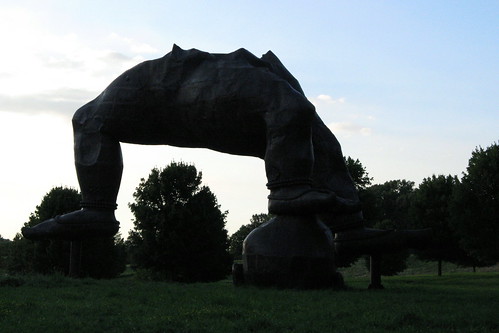
View the slide show larger in Flickr.



Thank you very much for this post. These are very powerful works, and it has even more impact because the artist is Chinese and is making a statement about history, religion, and the relationship between his country of birth and Tibet. It not only has aesthetic value, but as you say, healing value. I only wish the people of China and Tibet could see the works of sculpture as well.
Diana,
Thank you! I had not thought about Zhang Huan’s Chinese origins so much until you pointed that out. It is a powerful statement. In an interview with Pernilla Holmes, Zhang said that he thinks of these things as the problems that all humans face. Such artworks call to our humanity.
Your comments are very eloquent, and I appreciate them very much.
Susan
I do not see any mention of the three drawers that are built into the work: one in the rear left side of the head looking at the face from the front, and one each in the independent feet. These drawers are presently secured shut, but are for burning of incense which the artist delivered with the work. There are also holes in both independent toenails and in the lower portion of the foot resting on the head. What kind of incense is to be burnt and what is the significance of the burning of incense other than to facilitate a calming experience.
Thank you so much for this post. I had attended the opening and had no idea of all the background and meaning behind the sculpture. This is truly beautiful! And the experience of the sculpture itself in the space is also incredible. At the opening they had a group of monks from Palyul Namdroling monastery and a wonderful, 15-year old female singer by the name of Tenzin Kuensel. The monks chanted prayers and she sang beautiful traditional Tibetan songs. I wish I had known all of this background at the time because it would have made the experience all the more poignant. Thank you again.
Mary,
Thank you for your very positive and gracious comments. Thank you, too, for sharing your description of the opening. It sounds amazing, and I wish I had been there.
Such great artwork, in a beautiful natural setting, inspires us to live and be better, I believe. The sculpture’s opening sounds like it reflected that beauty, too.
Thank you!
Susan
I spent some time with this sculpture today, and was delighted to discover a surprise waiting for me in a place I didn’t expect it. I haven’t been able to find any mention of this aspect of the sculpture online, and I don’t want to spoil the surprise, but I encourage you to sit on the viewing bench that’s been placed off to one side of the sculpture and view it from there. I felt like I had been rewarded for taking the time to savor the sculpture from all angles; it opened my eyes to an entirely new dimenson of this piece. From the appropriate angle and distance, you can’t miss it. Sit on the bench…
Hello, Brad,
All I can say is: It sounds like I need to take another trip soon to the Storm King Art Center (a place I love). You’ve definitely piqued my interest! Thank you for coming to Mindfulwalker.com to share your discovery of a “new dimension” of this sculpture.
I’d encourage others to take a good look, too.
Grateful for your observations!
Susan
Hello, Susan,
I visited Storm King for the first time in a couple of years, and was blown away by this beautiful sculpture, which had been installed since my last visit.
I very much appreciate your treatment of both Storm King and the possible meanings of the sculpture: Is the head being trampled upon or is it arising? I, too, want to return to see the view from the bench that Brad observed.
Thank you for this blog — it’s filled with wonderful material!
Best,
Kathy
Kathy,
Thank you so much for your gracious and wonderful response to the Storm King sculpture essay and to Mindfulwalker.com. It makes me very happy, and I hope you keep visiting here!
As you can tell, when I first saw Zhang Huan’s “Three-Legged Buddha” it truly captured my eyes and my spirit. I find Storm King to be so restorative and inspiring, and I’m eager to check out the vantage point that Brad spoke of.
I’m sure if you were at Storm King recently during these spring days, it must have been so lovely. I’m happy that you shared your visit here, and if you have suggestions for other exploratory walks definitely send them along.
Happy spring!
Gratefully,
Susan
I love this sculpture and have a T-shirt from Storm King with its image on it. However, I’ve been reluctant to wear it in public as I don’t want to offend Buddhists. Do you think this is an issue?
Hello, Zuzu,
So many artworks are put onto T-shirts these days, and you raise an important question about this one. I would say first that I cannot easily answer this question as could an adherent in the Buddhist faith. My understanding is that images of the Buddha on clothing can be considered offensive. That is particularly true if it shows something that is counter to Buddhist beliefs (which this is not). In this situation, however, I cannot help but think that the artist’s depiction of the statue relics into a singular Buddha image – as a way to transform the suffering in the desecration of temples into art – could be different in its purpose. It may even be a teaching moment. My overall sense is that it would offend some, and not offend others.
Not having had this question before, I am going to read and research a bit more and answer further later on today. I also wonder what the artist, Zhang Huan, would think.
Thank you for your thoughtful question!
Susan